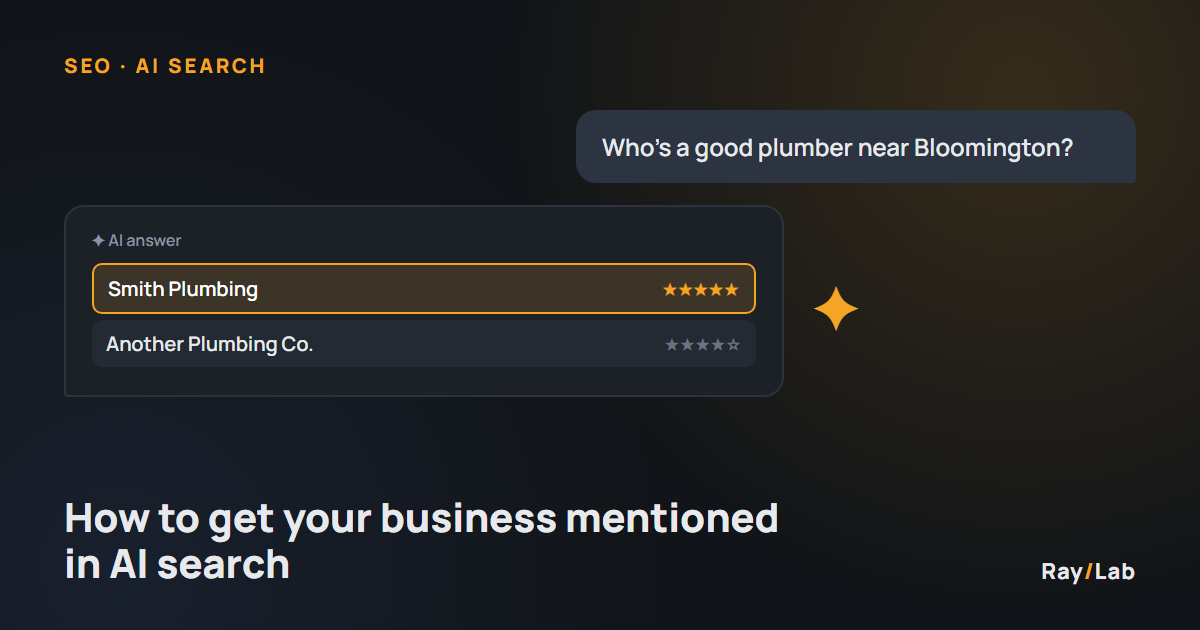
Not long ago, finding a local business meant typing a few words into Google and clicking one of the top results. Now a lot of people skip the clicking. They ask ChatGPT, “Who’s a good plumber near Bloomington?” or read the AI-written summary at the top of Google before they ever see a website.
If those tools mention your business, you’re in the conversation. If they don’t, a customer may never know you exist. The good news: the things that help AI tools understand your business are mostly the same basics that good websites already do well. Here’s what matters and what you can do about it.
How AI search decides what to mention
AI search tools don’t have a secret list of favorite businesses. When someone asks a question, they pull from information they can find and trust: websites, business listings, reviews, and other places your business is mentioned online. Then they write a short answer, often naming a few businesses and sometimes linking to sources.
That means they tend to favor businesses that are:
- Clear: it’s easy to tell what you do, where, and for whom.
- Consistent: your name, address, phone number, and hours match everywhere.
- Specific: your website answers real questions with real details, not vague marketing lines.
- Trusted: you have reviews and are mentioned on other reputable sites.
1. Say exactly what you do and where
Many small business websites open with something like “Quality you can trust.” That’s nice, but it doesn’t tell anyone, human or AI, what you actually do. Make sure your homepage and service pages spell it out in plain words:
“Smith Plumbing provides water heater repair, drain cleaning, and emergency plumbing for homes in Bloomington, Ellettsville, and Bedford, Indiana.”
One clear sentence like that, near the top of the page, gives AI tools something solid to quote.
2. Keep your business details identical everywhere
Check that your business name, address, phone number, and hours match on your website, Google Business Profile, Apple Business Connect, Yelp, Facebook, and any industry directories. If one listing says you close at 5 and another says 6, AI tools have to guess, and they may leave you out rather than risk being wrong.
3. Answer the questions customers actually ask
Think about the questions you hear on the phone every week: “How much does it cost?” “How long does it take?” “Do you serve my town?” “Do I need an appointment?” Add those questions and honest answers to your website, either on the relevant service pages or in an FAQ section.
AI tools are built to answer questions, so pages that already contain clear question-and-answer pairs are easy for them to use. Keep answers short and specific. “Most water heater replacements take 3 to 4 hours” is far more useful than “We work quickly!”
4. Add structured data (schema)
Structured data, also called schema, is a small block of code on your website that labels key facts for search engines: your business name, address, phone, hours, services, and FAQs. Visitors never see it, but it helps search engines and AI tools understand your page without guessing. Most WordPress SEO plugins, like Yoast or Rank Math, can add the basics for you, and Google’s free Rich Results Test will tell you if it’s working.
5. Build up reviews and mentions
AI tools pay attention to what other people say about you, not just what you say about yourself. A few habits help:
- Ask happy customers for a Google review, and reply to the reviews you get.
- Make sure you’re listed in your local chamber of commerce and any trade associations.
- Keep your profiles on industry directories complete and up to date.
- Share helpful content, like blog posts that answer common questions, that other sites might link to.
6. Check what AI tools say about you
This is the easy part. Open ChatGPT, Google, or another AI assistant and ask the questions your customers would ask:
- “Who are the best [your service] companies in [your city]?”
- “What does [your business name] do?”
- “Is [your business name] open on Saturdays?”
Write down whether you’re mentioned, whether the details are correct, and which competitors show up. If something’s wrong, like outdated hours, trace it back to where that information lives online and fix it there. Then check again in a month or two.
The bottom line
You don’t need to chase every new AI tool. Focus on the fundamentals: be clear about what you do and where, keep your details consistent, answer real questions, and earn trust through reviews and mentions. Those steps help you show up in regular Google results too, so the effort pays off either way.
If you’d like to know how your business currently shows up in AI search and what I’d fix first, get in touch.