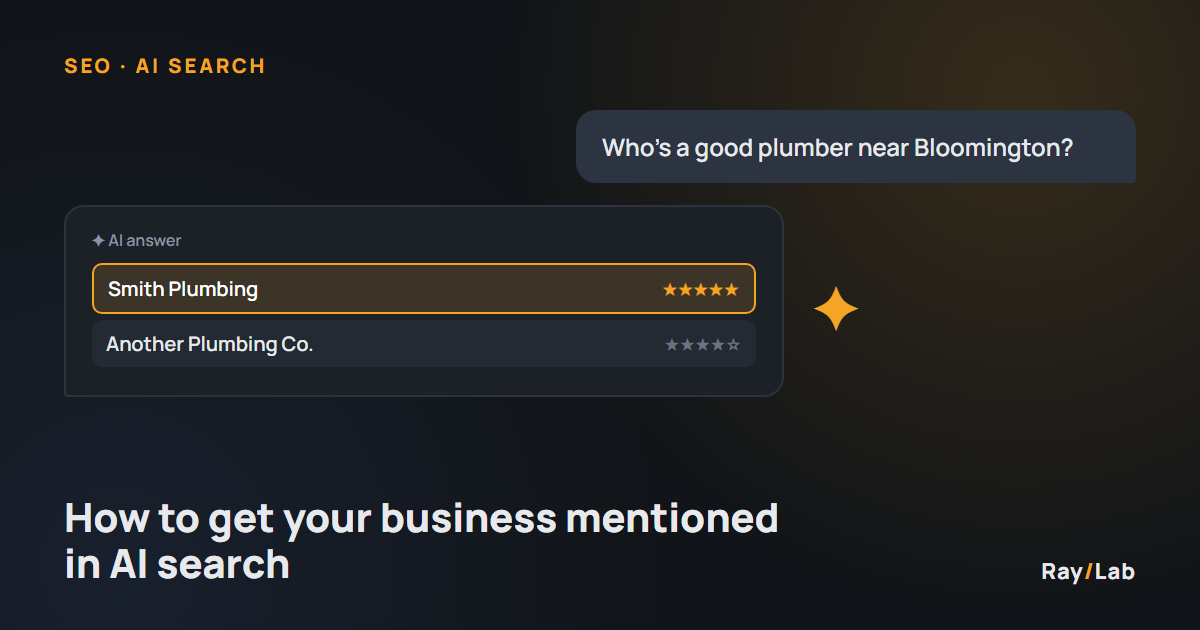
When someone asks ChatGPT for “a good accountant in Bloomington,” does your business come up? Most owners have no idea, and there’s no dashboard that tells you. The good news is that you can find out yourself in about 20 minutes, for free, with tools you probably already have.
This is the same basic check I run when I look at how a business shows up in AI search. Here’s how to do it, and what to do with what you find.
What you’ll need
- About 20 minutes
- A web browser, and a free ChatGPT account if you have one
- Somewhere to write down results: a notebook, a spreadsheet, or the scorecard at the end of this post
Step 1: Write down the questions your customers ask
Don’t start by typing your business name. Customers who already know your name aren’t the ones you’re trying to reach. Write down five or six questions in three groups:
- Finding questions, asked by people who don’t know you yet: “Who’s the best [your service] in [your city]?” or “Where can I get [problem] fixed near [your town]?”
- Name questions, asked by people who heard about you: “What does [your business name] do?” or “Is [your business name] any good?”
- Detail questions, asked by people who are almost ready to call: “What are [your business name]’s hours?” or “Does [your business name] serve [nearby town]?”
Word them the way a customer would say them out loud, not the way you’d describe yourself. A customer asks for “someone to fix a leaky roof,” not “residential roofing solutions.”
Step 2: Make sure the AI doesn’t already know you
AI tools and search engines tailor answers to the person asking. If you’ve searched for your own business a hundred times, your results may look better than a stranger’s. Before you start:
- For Google, open a private or incognito browser window.
- For ChatGPT, start a temporary chat and turn off memory or personalization for that chat if the option is there. These settings move around as the app changes, so look for them near the top of a new chat or in Settings.
- Put the city in every finding question. These tools often use your location, so naming the city makes your results closer to what a local customer sees.
Step 3: Ask ChatGPT
Type in each question from Step 1, one at a time. For each answer, write down:
- Were you mentioned at all?
- Were the details right: what you do, where you are, your hours?
- Which competitors were named?
- Which sources did it link to, if any? Click a few. They show you where the AI is getting its information.
Ask each finding question two or three times in fresh chats. AI answers change from one try to the next, so one answer doesn’t tell you much. If you show up in two out of three tries, that’s a much better sign than one lucky mention.
Step 4: Ask Google
Search the same questions in your private window. Google shows an AI-written summary, called an AI Overview, at the top of some searches but not others. If one appears, note whether you’re named in it or linked as a source.
Then click the AI Mode tab under the search box, if you see it, and ask again. AI Mode gives longer, chat-style answers and tends to name more businesses, so it’s worth checking separately.
While you’re there, look at the map results too. Google’s AI often leans on the same information that powers your Google Business Profile, so if you’re missing from the map, you’re likely missing from the AI answers as well.
Step 5 (optional): Try a few others
If you have a few more minutes, ask the same questions in Gemini, Microsoft Copilot, or Perplexity. Your customers may use any of them, and each one draws on slightly different sources.
What your results mean

You weren’t mentioned anywhere. This is common, especially for newer or smaller businesses, so don’t panic. It usually means the AI couldn’t find enough clear, consistent information about you. Start with the basics: a website that says plainly what you do and where, a complete Google Business Profile, and matching details on your other listings.
You were mentioned, but the details were wrong. The AI got that information from somewhere. Check the sources it linked, then look at your Google Business Profile, Yelp, Facebook, and any old directory listings. Fix the wrong detail where it lives, not just on your website.
Competitors were named and you weren’t. Look at the sources cited for them. Are they on review sites, local news, a chamber of commerce list, or an industry directory where you’re not? That’s often your to-do list.
You were named for your business name, but not for finding questions. That’s progress. The AI knows who you are, but doesn’t yet connect you to the service and the city. Service pages that name both, and reviews that mention what you did, help close that gap.
What I found when I tested my own business
I ran this check on RayLab Web Services. A Google search for my business name put me first, and Google’s AI described my business correctly, partly by drawing on my LinkedIn profile. That was a good reminder that profiles outside your website count. ChatGPT, though, didn’t mention me when I asked for web designers in Bloomington. So I’m doing what I’d tell a client to do: making my website clearer about what I do and where, and building up mentions in places these tools trust. I’ll keep re-checking.

A simple scorecard
Use a notebook or a spreadsheet. For each question, in each tool, write down:
- Mentioned? Yes or no, and in how many tries, like 2 of 3
- Details correct? Note anything wrong, like old hours or the wrong town
- Competitors named: who showed up instead of you, or alongside you
- Sources cited: which websites the answer linked to
One filled-in line might look like this:
“Best plumber in Bloomington?” in ChatGPT: mentioned in 1 of 3 tries. Hours were wrong. Named Business A and Business B. Cited Yelp and a local news article.
Put the date at the top, then run the same questions again every month or two. The trend over time matters more than any single answer.
The bottom line
You don’t need special software to know whether AI tools recommend your business. Ask the questions your customers ask, in a clean browser, a few times each, and write down what you see. If the results aren’t what you hoped, my guide to getting your business mentioned in AI search covers what to fix first.
I drafted this post with help from AI, and I checked the steps and final wording myself.
Want a second set of eyes on your results? Get in touch, and I’ll tell you what I’d fix first.